
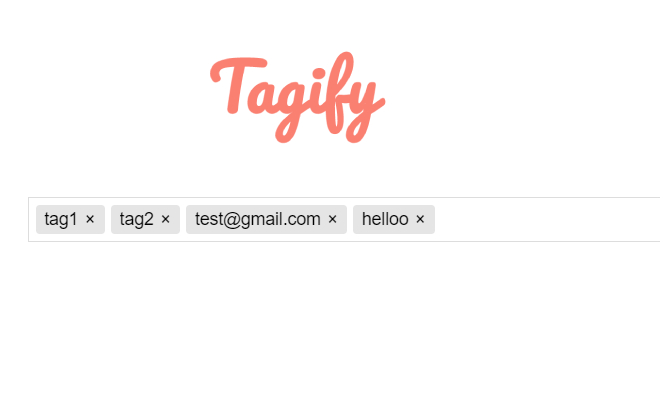
Apr 14, 2020 Tagify allows you to create a customizable tag input with as few variables as possible. Read More It is designed not to overwhelm a user with all of its possible configurations, exposing only the variables for the most common use cases. JQuery.tagify A simple UI control to turn any text input into a 'tagified' UI control. The value of the input will be split on the specified delimiter and create one tag for each item in the list. Tagify.me Use Playlists as Tags on Spotify. Have you tried tagging music saved in your Spotify library using playlists only to find you can't see which songs aren't yet tagged? Organizing your music can be daunting if there's no way of knowing when you're done. Passing the input element as a parameter to Tagify will transform it into a tags-component. Without any settings, the user will be allowed to create any tags they want, without a count limit. If the input element has a pre-defined value attribute, tags will be created from it. (Try Double-clicking a tag to edit it).
Project description Auto Tagify is a simple auto tagging module that uses NLTK to generate tags out of a selection of text. Any text that is less than 3 characters long or matches a particular POS (part-of-speech) will be ignored.
Tagify Login

A simple UI control to turn any text input into a 'tagified' UI control. The value of the input will be split on the specified delimiter and create one tag for each item in the list.
Include the jquery.tagify.js and jquery.tagify.css after you've included jQuery on the page.
Create a tagified UI control:
Tagify Hashtags

Optionally you can pass to tagify an options object to control various aspects of tagify. The available options are:
reset - $input.tagify('reset');


Reset the tagified input to an empty state. Note: This will remove any tags, and empty the input generated by tagify, but it does not remove the instance from the node.
Show me a Tagify UI that has: